“Mob hide-and-seek” is the second biggest series on the Maxx Storm channel and one of its longest lines: almost thirty episodes, a path from the village pig herd to a space base, single-color parrots, relocated cats, potions, clones and an eternal war with the bugs of homemade maps. In this guide we collected the whole hide-and-seek line in order: the rules and the flow of a round, the evolution of the maps, the sub-genres and the seeker’s tricks — with the key episodes embedded. If you’ve only seen a couple of videos, this article will put them into one picture.
The main rule: be one of them
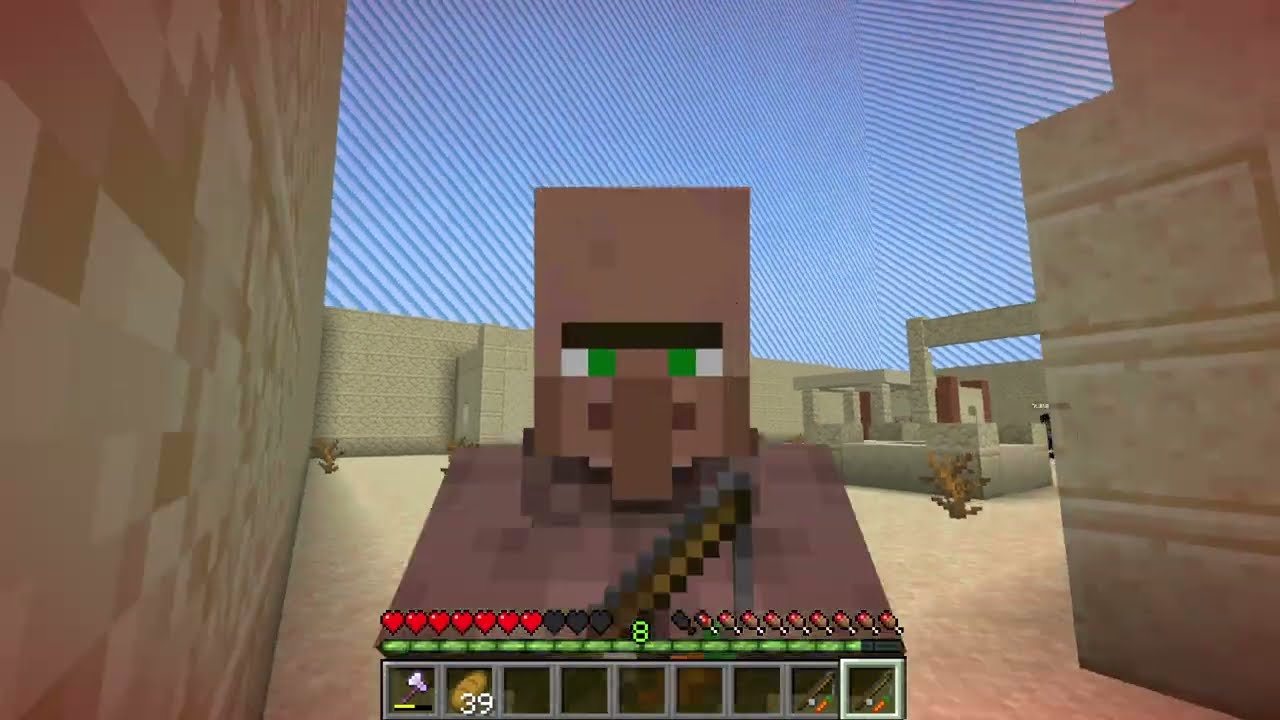
The hiding player doesn’t burrow into the ground and doesn’t fly off on elytra. He turns into a mob — a villager, a cow, a pig or a cat — and stands right next to a real one of the same kind. It has to look like a herd. A millimeter of error and the eye catches it: one pig stands a little sideways, one villager looks straight at the seeker. The transformation is done literally with the crosshair — aim and you become it, so the rounds move briskly, with no pauses for changing costumes.
The birth of the series: the very first episode
The series began with a simple experiment: Max gathered his friends Chili and Kumys and explained the rules right in the middle of the round. Turning into a mob takes one click, the seeker gets three or four minutes to search, and the hider has to press into the herd so that even a close-up look doesn’t give the fake away. That’s also when the scenes were born that fans of the series still remember today.
The debut immediately showed what the whole line would grow from: Kumys, hiding as a pig, moved too smoothly and got caught; hiding as a cat turned out to be harder — cats don’t look at the seeker, they run away — and Max stood behind a chicken that didn’t even exist on the map: purely for fun and to buy time. No complex mechanics — just eyes against someone else’s patience. We have a separate breakdown of the first episode on the site.
The flow of a round
A round is divided into three parts. First the hiders scatter and find “their” herd — usually ten seconds, during which the seeker stands with his back turned and doesn’t peek. Then it’s his time: two minutes to walk the map and figure out the fakes. Catch one — the hider is out, and the score moves the other way. Catch nobody — the hiders take the round. In paired play (like in the embedded episode) rounds go in turns: you’re the seeker — I hide, then vice versa, and the score is kept until a win.
The map update: the bunker and oxygen
The village map got crowded over time, and the hide-and-seek moved into a bunker. In the update episode the team “docks” a new section: opening the docking door means either losing all your oxygen or gaining a spacious new level, so the opening was made a separate scene of the episode. That’s also where the seeker’s briefing took shape: you take the killinator 3000, wait while the hiders take their positions, and open the hatches along the way — some shelters only work if you find the way in.
The bunker brought new jokes to the series. Becoming a “human” here is a bummer: instead of a villager the game gives you a wandering trader, instantly nicknamed the cheburek. A maniac settles in the sections, and you have to shut the doors in time against him — in this episode they were closed by Chili, who came with a new nickname playing a plumber and instantly earned the label “crooked plumber”. The clones need to be placed before the start — didn’t make it, consider the round lost. After this update the hide-and-seek finally stopped being village-style: it’s more like survival on a space station.
The killinator 3000 and other seeker rules
The seeker has a weapon with the telling name “killinator 3000” — it’s handed out with a few seconds’ delay while the hiders take their positions. By the rules of the updated bunker map, the seeker also opens the hatches on his way: some shelters only trigger if you find the entrance. And if a “maniac” is announced in the round, the hiders also have to shut the doors in time — surviving in a bunker where the oxygen runs out, all alone, won’t work.
Rounds with restrictions: why it’s not boring after 29 episodes
The secret of the series’ long life is rule variations. In one round you’re only allowed to hide behind cats. In another — only behind mobs of one color. In a third, the hider has the right to become a human once, dash across an open area and freeze again as a beast. On the bunker map there are clones and the “docking of sections” staging: you think you’re playing hide-and-seek, but you’re actually surviving on a space station. Hence the series’ internal memes — like the legend of the “villager with a baguette”, which the seekers recall every other round.
The space base: hide-and-seek in space
The biggest change of scenery — space. It all started with an unidentified rocket the team caught with a magnet: it pulled them to a space base where, as it turned out, David had been living for half a year and built the station specifically for mob hide-and-seek — with the killinator from the village version, a cafeteria and a classified bedroom that had room for hiding spots.
Then came the story twist: the base is attacked by homing missiles, the crew takes an escape pod to a secret bomb shelter — and since the explosions can’t be heard behind perfect soundproofing, they play hide-and-seek there. The map turned out cramped: the seeker walks all the hiding spots in a minute and a half, so the timer was cut. When things settled, the team returned to the base — the radar showed not a single scratch on it, but it did have Anya, who appeared out of thin air, and the “spin or keep” roulette that became the main ritual between rounds. How the station works — in the article “the space base“.
Sub-genres: parrots, cats and ely
The longer the series lived, the more sub-genres appeared in it. The parrots arrived first: under an unknown tunnel a separate map opened where rounds are played by color — first everyone hides behind red parrots, then green ones, and in the finale behind random ones. That’s how the “freedom for parrots” meme was born, along with the hiders’ eternal trouble: a parrot’s crest sticks out, and it gives away even a perfectly placed figure. The maps kept getting tighter: in the modernized bunker you get only a minute to search, and moving from a hatch to the bunker and back is forbidden.
In parallel the cats moved to the new bunker map — together with the new participant Rasul. That’s where the hideout-switching tactic was born: as soon as the seeker starts checking one shelter, the hiders run to the neighboring one, and the hatches are closed in advance so you can’t figure out who went where by them. One round got ridiculous: for the legendary “villager with a baguette” no villager could be found — they had to hide as a cat.
There’s also the guest episode with the telling title “I am ely”: the least noticeable in it was declared to be the gray parrot, climb into a hatch — you can only be a cat, and the seeker is chosen by “rock-paper-scissors” right in the chat.
And finally the chameleons — a sub-genre that stepped beyond Minecraft: the hider doesn’t turn into a mob there, but paints themselves to match the wall, and the episodes with the signature “everything will be fine” are a separate pleasure. How cats, chameleons and camouflage hide-and-seek differ, we break down in the article “cats and chameleons“.
The series’ bugs and how I fixed them
Homemade maps have a main enemy — bugs, and the series doesn’t keep it a secret. Every now and then Max announces: “a whole bunch of bugs on our mob hide-and-seek map has been fixed, and now cheating will be practically impossible” — and invites his friends for a control round. In one update the bunker got sleeping bunks for the kitties and a healing sanatorium, in another they tested whether the map could be glitched through a hiding spot in navigation, where Max spent the entire round.
A separate chapter — potions. The locomotive potion turns escaping into a ride of its own, the speed potion lets you run across the whole map, and “moonshine power”, as the check showed, doesn’t work at a hundred percent. All these wonders have one price: the bubbles and the sound give them away, so the rules gained a clause: “if I gave you speed, it doesn’t mean you can run all over the map”.
The stress test ended logically: having made sure the map holds and other people’s tactics don’t break the rules, the team packs up and flies back to earth — for new maps. The full list of improvements is our bugs breakdown.
The roots: hide-and-seek in Among Us
Mob hide-and-seek has direct ancestors — hide-and-seek in Among Us. When the official hide-and-seek mode came out in the game, Max was among the first to test it: the impostor is known from the very start, their job is to cut down the crew before the timer ends, and everyone else’s job is to survive those two and a half minutes. The sensor helps: the flashlight next to the impostor changes color — gray means far away, light blue means careful, yellow means close, red means they’re right behind the wall.
The rules there are Spartan: you can’t report bodies, tasks can be ignored, vents can be used a limited number of times, and the best places to survive are disinfection and the cafeteria, where the impostor is visible from afar. It was from matches like these that the “eyes against patience” mechanic grew, which mob hide-and-seek later perfected. That story is covered in the piece about the first Among Us matches.
How to spot a fake: three seeker tricks
- Look not at the mobs but at their arrangement: a fake usually stands a little too neatly, the way a real villager doesn’t.
- Check places where a mob would be strange: the only cat on the roof is suspect number one.
- Count. If the village had seven villagers and now there are eight — the eighth is waving its hand in a very un-villager-like way.
Who will enjoy this series
If you like our hide-and-seek in Among Us but want something quieter and more playful — “Mob hide-and-seek” is exactly that: no voting and no traitors, just your eyes against someone else’s patience. It’s one of those crowd mini-games that’s easy to rebuild on your own server — you need a morph plugin and a map with dense mobs. How we make maps and who draws them, we tell in the channel section.
The bottom line: “Mob hide-and-seek” is an attention game disguised as a comedy. The hider needs perfect stillness: don’t move, don’t stand out, be a pig among pigs. The seeker needs only attention and a bit of nerve. Judging by the score in the embedded episode, the score is roughly even — meaning everything most interesting is still ahead.
You need three things: a morph plugin (turning into a mob), a map with dense groups of mobs and a round timer. The easiest way is to start from a ready mini-game plugin pack and adjust the rules to your group: the “cats only” restriction is the funniest one, by the series’ experience. Server core and memory requirements we covered separately in the servers section.
Want to repeat the channel’s season — build it the same way. Map: start with a dense mob herd, add a bunker with hatches and a maniac, then the space base and a separate map for parrots. Round rules: a timer from one to four minutes depending on how cramped the map is, color rounds behind parrots of one color, unique mobs so figures don’t overlap, hatches closed before the start and no potions if you don’t want arguments about cheats. Between matches spin the “spin or keep” roulette and keep the win score between episodes — that’s exactly what held the line of dozens of episodes together.