Every kids’ crew has a game they come back to for years. For us it’s “Snipers” — the longest-running series on the Maxx Storm channel: no other format comes close in the number of episodes. Across the whole line there are more than forty-eight episodes, seasonal series count over seventy, and along the way the series grew its own seasons, modes, special maps and a whole dictionary of terms a newcomer gets lost in within a minute. So we put everything into one big guide: from the first episode on a village map to record-breaking matches against the sigmas. We’ll also cover the separate duels with pros that run outside the seasonal numbering. Below is what you need to know before your first viewing (or your first match with your own crew).
The point of the game: precision against speed
“Snipers” is duels and team fights on custom maps where position beats reflex. Two squads land on the map from different sides and hunt each other through scopes. One shot — and it’s usually your last: hence the series’ core skill, moving from cover to cover and never showing yourself in the same window twice. The titles are simple: “Minecraft but we became snipers”, “A new friend in the snipers game” — and every episode adds something new to the rules.
The birth of the series: first episodes on our own server
The series wasn’t born on a ready-made arena but on a private modded server. In the first episode Max, David and Arseniy hid all over the village: the rules were set right away — no peeking into other people’s chests, ten seconds to scatter, no extra mods. From the very first episodes Max posted the server IP and the mod list with the video. The map was temporary, and the crew didn’t like it: right in the episode they promised to build a proper city — later they kept that promise. The debut went to David: he took three rounds in a row, after which they decided to refresh the arsenal before the next match.
The second episode is remembered for an expose: Arseniy noticed Max had switched to creative mode and demanded justice — “the subscribers will confirm”, as they joked then and still joke now. In the third they invited Varya and thought about balance for the first time: two against one isn’t fair, so the teams were given helmets, and to avoid confusing friend from foe, one player got a banana in his right hand. By episode seven, “two against one” had become a signature sub-genre: Arseniy and Varya hunted Max, the seeker was picked with scary counting rhymes, the guard got taken out first, the scout right after. That time the duo won: the first big grudge in the series’ history. We broke down how it all started separately — in the piece about the first episodes.
How a round starts
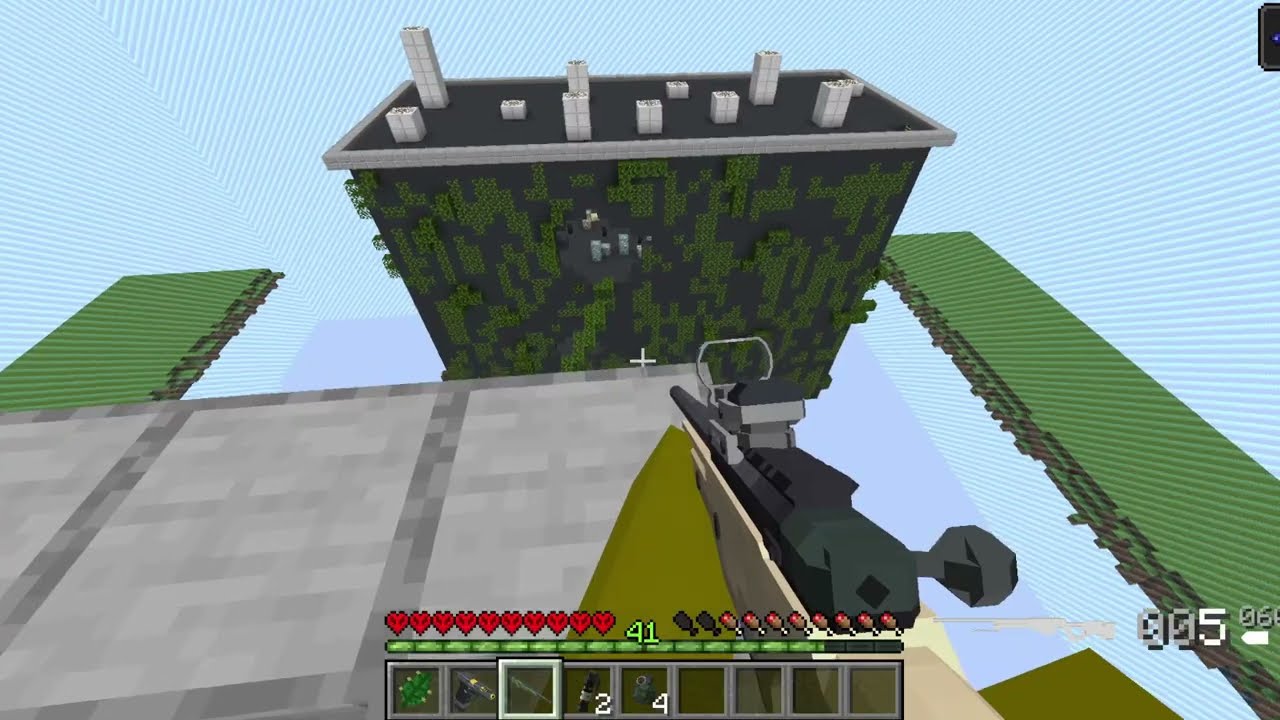
The drop is the signature moment. The team jumps out of a cargo bay with parachutes and picks where to dig in: our landings happen both in the thickets and on the roofs of high-rises. Then — loot: rifles, pistols (the map sometimes has rare named ones — players call them “server uniques”), grenades and ammo are laid out across the map, up to a .338 Lapua caliber. Whoever assembles a proper “weapon plus ammo” combo first already controls the pace of the round.
2-on-2 duels and everyone for themselves
Once the basic format was mastered, the variations began. In the fourth episode they played “everyone for themselves” for the first time: the rule “don’t run past the village” appeared, flashbangs went into action, and the best hiding spots turned out to be on roofs and in foliage. That’s where the first nicknames were born: Varya asked to be called Sparrow. The fifth episode is classic “two against one”: Varya and Arseniy against Max, the pair got totems of undying as compensation. That’s also when the main weapon-picking principle was formulated: shotgun for close combat, rifle for long duels, SMG for mid-range.
The sixth episode brought the full crew in pairs: Varya, David and Arseniy played rounds on shotguns and flashbangs, and it became clear Arseniy had finally learned to play. The eighth added chaos: technical failures, reconnects and “smoking out” grenades into the most shameless hiding spots. The ninth brought a new microphone and a rule of decency: die — switch to spectator and don’t mess with the round. Between rounds the teams swapped spawns and locations so the hiding spots wouldn’t burn out. The match went to Max again. A separate breakdown of the duel formats is in the piece about 2-on-2 duels.
Points, portals and the vertical game
The series’ maps are a city: a street, an office, neighboring buildings with roofs. The map has capture points — marked with letters, and they’re the center of the main fight: point “E” is considered the best position, as they yell at the top of their lungs in episode 21. Between the buildings work the little portals — teleports that save you when you’re pinned down. And when you need to change roofs, paragliders come into play: flying between skyscrapers under fire is the most cinematic part of a round.
Modes and special maps: grenade king, detective, ghosts, bunker
By the middle of the line the series had its own modes. In “grenade king” (episode 68) everyone has their own point on the updated map: you can’t leave it, the score goes to five, and after three points the opponents swap places. Rounds here turn into an exchange of medkits, grenades and bunny hops, and the winner’s parting advice to viewers is “learn to throw flashbangs”.
Episode 69 — “the detective”: one hides for a minute, the other searches with a timer. You can hide anywhere on the map and search by sound, by rendered geometry and by hints like “green, like Shrek”; ceilings, sewers and three-story buildings get checked, and champions know how to re-hide in the middle of a round. In ghost mode (episode 43) they play in threes with Romer and Chili: one gets a highlight glow and invisibility, the score is evened out with medkits and speed — in open ground you can’t hide from a ghost.
A separate branch — special maps. The underground bunker from episode 16 is billed “no horror”, but it has ventilation hatches: you can only smoke out whoever camps in the vents with a grenade. That first run ended 4–4 — they never managed to smoke each other out. In episode 25 the same map hosted a five-player “everyone for themselves” — the map had to be modernized for such a crowd. All the mechanics are collected in the modes catalog, and the creepiest arenas are covered in the piece about special maps.
Sigmas, the team and episode chronicles
The team grew, and so did the mythology. By episode 70 the lineup was polished to the level of “best team”: players cover windows on call, switch positions without extra words and smoke rivals out of the most shameless spots. Hide-and-seek in the elevator shaft and checking every balcony — their signature moves.
One of the fans’ favorite episodes is the introduction of Semyon, invited as the owner of “the best sigma on the server”. The newcomer was shown a four-building map and taught the main survival rule: only peek through F5.
Then the sigmas met face to face: a residential complex appeared on the map, six players first played “everyone for themselves” and then split into trios. The odds were evened honestly: the AWP, a one-shot killer, was taken away mid-match from the team that started pulling ahead. The finale of that meeting was moved into a separate episode — that’s how two-part chronicles appeared in the series. The sigmas became regular characters — they get hidden in sewers and on cranes, the whole lineup hunts them, and the title of “best sigma” has to be defended round after round.
The episode chronicles are also the map’s chronicle. In episode 26 the abandoned building was updated: Ruslan climbed a five-story building with a rifle, while he was led around positions and taught to move while holding shift. In episode 28 the office was attached to the map, new “needle” pistols were handed out and a teleport with ten seconds to scatter was added — that match’s final ended in a draw. Later a three-story building in the style of a research institute grew on the map, where the grappling hook only latches on from one side, and in the “friend became a pro” episode Likha suddenly delivered a level nobody expected from him, and Semechko got an award as one of the best snipers players. The full timeline by episode numbers is in our episode chronicles.
Cheaters, camouflage and legal cheats
A separate chapter of the story is the “cheater season”, in jest. In episode 38 Max and Romer walked the map without cover and winked at the viewers: they had “cheats for this episode” — cameras in the sewers that see through invisibility, and “new collection” suits. The opponents raged in the best traditions of the genre: how long are you going to keep these cheats?!
It all started earlier, with camouflage: from episode 11 Max repaints his skin for every map to blend into trees and the ground — before that, a yellow suit gave his position away a hundred blocks away. The skin is redrawn before every match: finding “the most camouflaged” one became a goal in itself. The rules have nothing against camouflage, unlike armor: you can’t wear it, which the heroes occasionally violate by accident.
By episode 12 the series had formulated the main commandment of an honest sniper: Minecraft has legal cheats. Changing spawn, ammo from chests, teleports and vanilla mechanics tricks — all allowed; but flying out of the map border or through blocks is already a murky story. How it looks in combat — in the episode below.
By episode 39, “the cheaters clashed” as teams: each was given teleportation pearls — sixteen for one participant — and the tactics shifted to “take out the strongest first”. Blind grenades went into action from the first seconds of the round in that format. We made the most honest breakdown of that season in the piece about the cheater season.
Team tactics in three phrases
- “Loot up, I’ll cover” — the commander splits the roles: who collects weapons, who holds the street.
- “They’re in the next building” — information beats accuracy: whoever spots first wins the firefight.
- “Never show yourself twice from the same window” — the rule behind most of the series’ painful fails.
Seasons and why the series lasts so long
“Snipers” restarted in seasons: a new map, new rules, sometimes a new player — like in episode 21, when Ruslan joined the team. The format survives solo “1 vs 3” duels, “everyone for themselves” tournaments and team battles. That makes the series close to the big server mini-games played by crowds: simple rules, endless variations. If you want to repeat it at home, start with a stable core and low ping: in sniper duels milliseconds matter more than the scope. We wrote about choosing arenas in the review of popular servers and their genres.
Where to start watching
The episode embedded above is the starting one — the basic rules are clear in it. Then we suggest this order: the first episodes, to see how the series was born on a village map; then the modes and special maps; after that — the sigmas and the chronicles, where team play reaches its highest level: the sigmas are the funniest layer of the series, the chronicles are the richest in tactics. If you want a modern production right away, start with episodes 68 and 70. Who Karas, Likha and Slava are and how the team is assembled — told in the piece about our channel.
The bottom line: “Snipers” is speed chess with parachutes, stretched across dozens of seasons and seventy-plus episodes. The rules take a minute to read, but on the map everything is decided by patience, and between episodes a whole universe grew: modes, special maps, sigmas and its own mythology. We’ll keep adding to this guide as new episodes come, so bookmark the page: whoever shows themselves first is usually the one who saw the round from the side of the screen you don’t come back from.
The minimal set: a city map with roofs and cover, a weapon-giving plugin or ready kits in chests, a round timer and an agreement “one life — one round”. Set the team spawns on opposite ends of the map and add teleports between buildings — that’s what our “little portals” are. The subtleties of picking a core for mini-games are a topic for a separate article in the servers section.