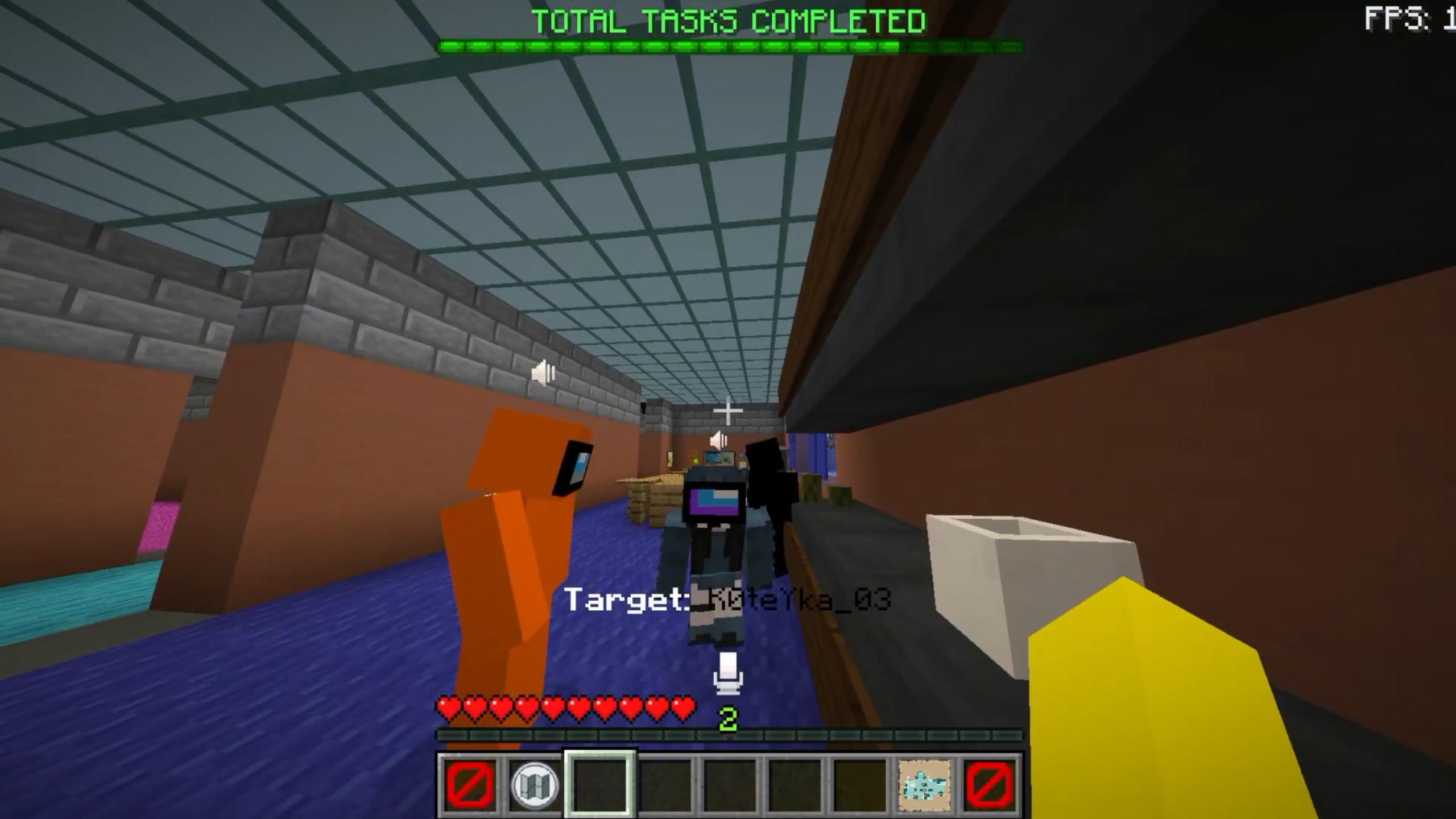
Among Us in the cubic world isn’t a port of one game into another but a convenient wrapper: the same social logic of “find the impostor” gets a space where you can hide, run across locations and build hints for your own. Below — how this series works on our channel, how it differs from the original, and what you need to assemble the same game at home.
Why this combination works at all
The original is built for the enclosed space of a ship: short paths, cameras, tap-tasks. In Minecraft, the same rules get the freedom of physics — the impostor can not just catch up with the victim but lead them into a built trap, and the crew can wall themselves off with a door or leave through a shaft. That’s where the interest holds: every round runs on a different map and different geometry.
The second difference — the tempo. In the original, discussion is tied to the emergency-meeting button; here the conversation goes in chat and voice constantly: the tension is created less by the kill than by someone digging in a corner too calmly.
Basic rules: what stays from the original
The core doesn’t change. A round has four to fifteen participants: the majority are crew, one to three are impostors. The crew wins when it completes all tasks or figures out and votes out the impostors. The impostors win when they match the crew’s number or sabotage the work so badly the tasks can’t be finished. Sabotage, repairs, meetings, voting — all of it is here too.
What the Minecraft version adds: three kinds of roles
The main difference of our series — the expanded role grid. Besides crew and impostors, extra roles of three kinds appear in a round: impostor ones, peaceful ones and neutral ones. It’s the neutrals that make the game funny: you can win without any team at all.
| Role | Kind | What it does | Win condition |
|---|---|---|---|
| The Silent one | impostor | shuts one participant’s mouth: at the vote that player can’t speak, afterward they can again | with the impostors |
| The Doctor | peaceful | revives a found player; without a discovered body it doesn’t work | with the crew |
| The Liquidator | neutral | gets a target at the start of the round and must vote them out without falling under suspicion himself | solo: the target is voted out |
| The Jester | neutral | the opposite task — it needs to be voted out itself | solo: voted out first |
The point of this add-on is simple: in regular Among Us a player is either with the team or against it. Here a third position appears — a person playing for themselves who genuinely messes with everyone, because their behavior can’t be explained by team logic. Rounds with two neutral roles get the best reactions.
How to assemble such a game at home
Three paths, from the simplest to the most interesting. We deliberately don’t put links to third-party resources here — search for the platforms by name, they’re found within a minute.
- A ready-made map location. The community makes maps replicating the original locations with their rooms, vents and tasks. The fastest option: a map plus a group on one server, and you can play the same evening.
- A client mod. Adds roles, tasks, kills and a meeting interface. Requires installation for all participants — but the rules can be configured: impostor count, speed, cooldowns.
- A server-side implementation via plugins. The most stable option for a regular series: the game logic lives on the server, participants join with a normal client, and rounds can run on a schedule. The entry bar — knowing how to install a core and configs.
What gets configured before a round
- The number of impostors and neutral roles. For six to eight people — one impostor; for ten and more — two or three, otherwise the crew wins mechanically.
- The vent and pipe rule. Agree in advance whether traveling through pipes counts as legal: without this rule half the accusations hang in the air.
- What to do with a body. In the original everyone who entered the room sees it. In the cubic world the body is a block or a mob: fix the rule of how it’s marked.
- Voice or text. A voice meeting is fairer but needs Discord or a voice mod; text is simpler and slower.
How it differs from the original: in short
| Parameter | Original | Minecraft version |
|---|---|---|
| Space | fixed maps | any built location |
| Movement | walking, vents | running, jumps, blocks, portals |
| Roles | crew, impostor | plus peaceful, impostor and neutral |
| Tasks | taps in rooms | real actions: build, craft, bring |
| Observation | interface cameras | built cameras and the Eye of Ender as an item |
Who’ll find it interesting
A group of six or more that already calls each other. Fewer — not enough suspicion; more — the meeting turns into a bazaar. If you have your own permanent world, the series fits it without reworks: no separate venue is needed, just a zone you build as the location.
And the last thing we haven’t decided yet: can you influence the vote after dying. In the original — no; in our version — by the round’s agreement. Fix it before the start, or the first argument will strip the episode of all its fun.
The theme continues on our channel: “Escape from the madman’s house” — the same social genre but with character classes instead of roles, and “The Pizzeria Simulator” — a completely different format where there are no impostors to find. The full list of series and how we film them — on our channel’s page.
A client mod gives more roles and flexibility but requires everyone to have the same thing installed. A server plugin demands nothing from players except an honest login to the server, but is limited by what the developer put into it. For filming the series we pick the second path: less desync on the recording. How the choice between mods and plugins works in general — in the text about the difference between cores.
A mini-game lives in a separate zone, so before the first round it’s worth doing three things: restrict build rights in the rest of the world, enable inventory saving between rounds, and put anti-griefing protection on the venue itself. Otherwise one bad round wipes the build. The beginning is in the collection of protection plugins for beginners, and if you don’t have a server yet — in the guide to your first world.
All the episodes of the series and fresh records — on the Among Us series page.