Updated (07.11.2026): the series grew into a “second pizzeria”
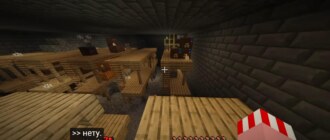
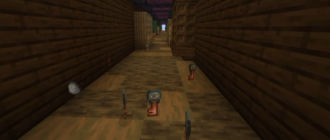
The two-shift format moved on, and three plots are worth adding to the article. In the episode “I bought a new pizzeria” the hero opens a second location and restores the first in parallel: cobwebs in the corners, boxes in the kitchen, ventilation — that’s how two businesses and two night shifts appeared in the series at once, and the money from inspections went into the loan and advanced qualifications. Next he assembles the full animatronic catalog from the “vintage” part — Bonnie, Chica, Foxy and Sparky — and learns on his own skin the rule familiar from the table below: the inspectors nitpick not only cleanliness but also how well the set fits the hall’s theme. And in the episode “I secretly watch my animatronics” a surveillance camera system appears: the bought monsters are now watched from a monitor, and the night shift turns into quiet surveillance of your own property — it’s embedded below. For those who want to compare the Minecraft version with the source, we have a breakdown of the real FNAF 6: pizzeria by day and night shift.
“The Pizzeria Simulator” — a series on our channel where I play the owner of a pizzeria and its own night guard. The format is built on two shifts: by day you put the place in order, by night it starts living its own life. Below — how the rules work, what the salary is made of, and why we chose this combination at all.
The setup: two shifts in one pair of hands
The game starts with one pizzeria. Your task is not only to run it but to renovate: restore the premises, buy decorations and animatronics. Every second qualification upgrade grants a new pizzeria — the project grows not linearly but in jumps: earned a level — got a harder location.
The night shift kicks in after eleven at night. At night the animatronics come alive — and that’s exactly when the most interesting part begins, because you stay in the building one-on-one with what you yourself bought. In the morning, at six, money is credited; the amount depends on your qualification.
Where the salary comes from: what to count as success
| Factor | How it affects | What to do about it |
|---|---|---|
| Qualification | the base multiplier of the payout | grows with completed shifts and renovated locations |
| Repair quality | lowers the payout for broken tiles and unfinished work | don’t put off repairs until “after the shoot” |
| Animatronic match | the inspector lowers the score if the set doesn’t fit the pizzeria | pick mobs to match the location’s theme, not “whichever I like” |
| Morning inspection | a separate payment from the inspector or the critic | keep the lighting and order until they arrive |
The point of the mechanic is that money here is credited not for survival but for housekeeping. It’s a rare Minecraft format where the player is responsible for a property: you can survive the whole night and still come to the morning and get less, because you didn’t fix the floor.
Who films the series
The set was built by members of our team — they also play the inspectors, the critics and the other people appearing in the episodes. For the viewer this matters: the series has live characters, not only mobs, and it’s precisely because of this that the morning-inspection scenes work as standalone plots.
How it differs from the animatronic horror
The original genre about a pizzeria with animatronics is about fear: hide, survive, don’t get caught. Our setup flips the task: you’re not the victim but the owner. You chose these animatronics yourself, built the hall yourself and answer yourself for the place looking decent in the morning. The night part gives the tension, the day part — the goal. Hence the tone: not horror but a workplace comedy with ghosts.
What goes wrong during filming
To be honest: mishaps happen constantly during shooting — from dropped connectivity to the “night shift” not triggering on time because someone’s client reskinned. We don’t reshoot every take because of that and don’t cut everything: some of such moments stay in the episode, because they explain the format better than any instruction. The series is new, and its rules are still being refined as we go.
How to assemble a similar venue at home
- Building the hall. The pizzeria is built like a regular building: a counter, a dining hall with tables, a back room, a mezzanine. The only difference is lighting — at night it must be visible where exactly the dark corners are.
- Animatronics. They’re made from mobs with renaming and a texture, or you take ready animatronic mods. The second path requires the mod to be installed for all participants.
- The night-shift rule. Easiest to implement with a scheduled server command: at a certain hour a separate set of events turns on. That way you don’t depend on who reached the lever first.
- The economy. Payouts run through in-game currency or an economy plugin: pay per shift, a fine for destruction, a bonus for qualification.
What to watch in the new episode: three points
The format rests on three scenes, and knowing them in advance means not missing the main thing.
- The repairman’s evening. Inspecting the premises: what’s broken, what’s missing, which animatronics to buy. Here you see how the pizzeria changes from episode to episode.
- The night shift. From eleven at night until six in the morning. The point isn’t the scary moments but that you stay in a building you built yourself and hear someone walking around in there.
- The morning with the inspector. The funniest part: a live person inspects your work and lowers the payout for broken tiles. This is where you find out whether fixing everything before the shoot was worth it.
How long the series lives
The format is finite by its logic: once the qualification upgrades and pizzeria variants run out, there’s nowhere to play further. We plan a season of roughly six to ten episodes and deliberately don’t stretch it: better to close the series at its peak and move to another location than to film the same hall for the tenth time. New episodes come out in the channel’s general playlist.
Who’ll enjoy this format
Both those tired of pure survival: here you don’t mine — you maintain. It also lands with viewers who like short episodes with a clear rule: shift — morning — result, and every episode ends with a number in your pocket. Plus a separate audience — fans of the animatronic genre: there’s the aesthetic and night tension here, but no hard horror, so you can watch even at ten in the evening.
If formats where you search for a traitor instead of repairing the floor are closer to you — watch the series Among Us in Minecraft and “Escape from the madman’s house”. All the channel’s series, the schedule and how we join the team — collected on our channel’s page.
Three things without which the episode falls apart: stable recording from two sources (game and voice), the shift rules agreed in advance, and an agreement on what to do when a participant drops. We didn’t get there right away: the first episodes had to be re-edited exactly because of the missing last item.
Ready animatronic mobs are installed with a client mod, but for a regular series a server-side implementation is more convenient: the rules live on the server, and participants join with a clean client. Which modpack such a venue demands hardware-wise — in the text about the memory calculation for a heavy pack, and how a plugin core differs from a mod pack — in the breakdown of the difference between cores.