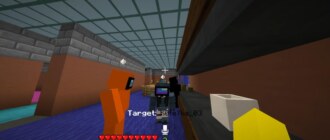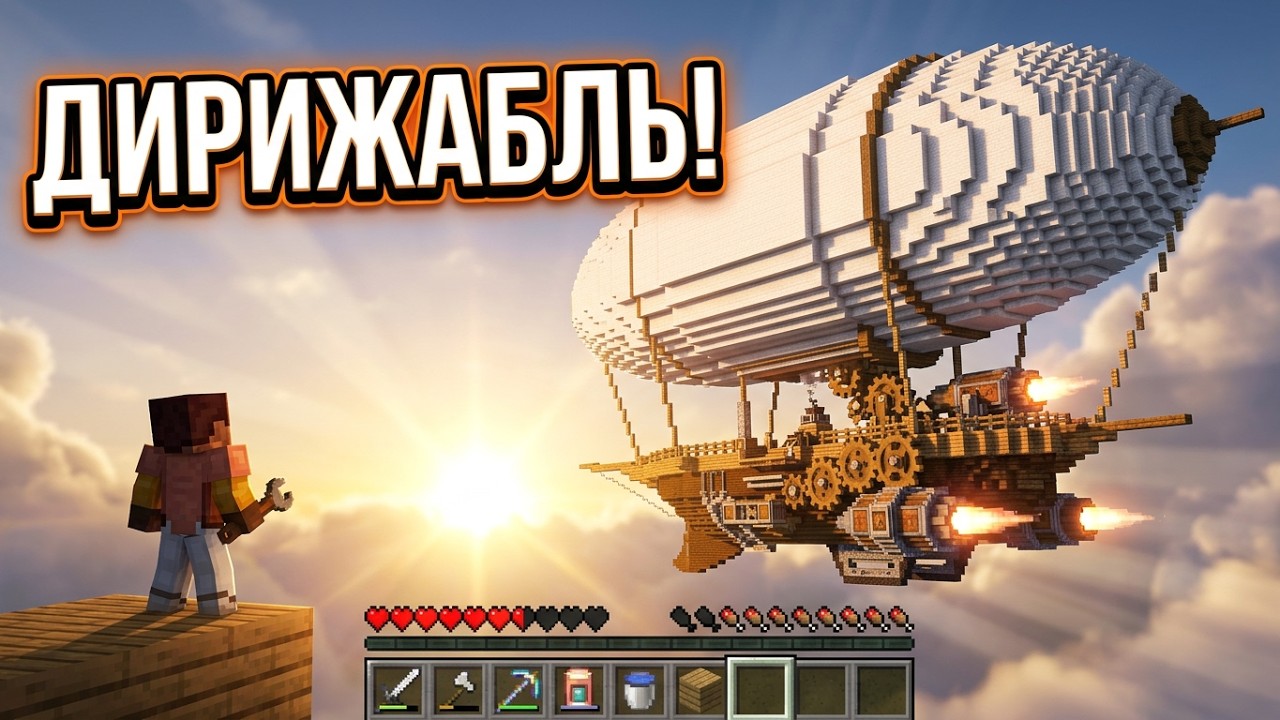
“100 days in Create Aeronautics” is a series on the Maxx Storm channel where Max and his team survive on a server with a mod that adds real physics to Minecraft: everything you build actually floats, drives and flies. The idea is simple — over a hundred in-game days, go from the first mechanisms to machines that are hard to believe in. We watched the episodes and break down how an iron factory grew into a port with a crane, and wool and a burner became an airship that got off the ground. Even if not on the first try.
The point of the series: what physics changes
Create Aeronautics lets you assemble working mechanisms and transport — all-terrain vehicles, ships, planes and airships. Blocks in an assembled structure become a single whole, so any machine can be started and driven. Max invited the team to one server to go, in a hundred in-game days, from simple devices to “crazy machines”. In practice it didn’t stop at a hundred days: by part three the heroes were counting day one hundred fifty. And the team lineup is alive and chatty: next to Max are Grepa, Varya and Kapibara, and Max got a dog named Krap — yes, Krap, not crab.
The chronicle: how it all began
Part one is classic survival with a physics twist. After dying in the mine, the hero finds a village and settles a beach that’s destined to become the main base. Then — factories: iron needs brass, an alloy of copper and zinc, and to smelt it you’ll need a flare burner charged only in the Nether. The processing mechanics are built from millstones and troughs — eight of them, so cobblestone is guaranteed to land where it should — drills are added, and the team meets overloads with horror: a structure without wheels simply stops. By day fifteen the iron factory finally earns.
The chronicle: ship, port and crane
Part three is about water transport: the ship’s frame gets propellers, a steering wheel, an engine and an analog gearbox. Oceans are convenient with a pair of double chests of resources, but turn timings, running aground and reverse thrust turn every walk into an adventure. A separate line — the precision mechanism: with an eighty percent chance the crafting produces the needed part, and twice in a row the hero got junk. By the end of the part the team builds a port and a crane from industrial iron — the pilings alone took a whole stack — driven by a combination of water wheels, a clutch, reverse and a winch. Part four, judging by the title, is entirely about the giant crane; from the fifth we know Grepa started pumping oil in parallel.
The chronicle’s finale: the airship and the big rollback
Part five opens with a bitter discovery: for a day and a half the team pumped oil where there is none — Grepa picked the wrong chunk. But by then the base commands respect: iron and quartz factories (gold was re-profiled because the find chance is tiny), cellars of black and cherry wine, the “Nazerak” ship on a remote control and a fully working ship crane. The main plot — the first aerostat: wool for the envelopes, scissors, a copper jetpack — and tests where the airship lacks thrust, the steering system fails and the machine ends its flight with a water landing. In parallel goes the engine revolution: a diesel generator, Grepa’s gasoline engine and talk of a propeller plane where the flaps will be the hardest part. Add the plans for a flying restaurant with “tasty points” and a four-by-four drill to bedrock — and you get a typical day of this team. The finale is predictably loud: the server crashes from a bug on contact with water, and only a rollback to a backup saves it.
The mechanics: what a takeoff is made of
- Resources and processing: millstones, troughs, drills, iron, quartz and gold factories.
- Energy: water wheels, diesel and gasoline engines, steam options, chain drives.
- Construction: wheels against overloads, propellers, steering wheel, gearbox, flaps for future planes.
- Infrastructure: port, pilings, crane with winch, liquid fuel tanks.
- Team: everyone has their own build site — oil, wines, crane, ship.
Where to start watching
For newcomers — part one: the idea itself is explained there and you see how the base is born. Water-transport fans — part three, and the airship and the final rollback await in the fifth. If you want to understand the mod deeper, we have a separate breakdown of the mod and the first machine. And you can join Max’s team via the link in video descriptions — recruitment opens periodically.
Three practical lessons follow from the chronicle. First: the mod is heavy, so a server with a big modpack needs memory headroom — we wrote about how much RAM a server with two hundred mods needs. Second: make backups — a bug on contact with water took down the team’s server, and only a rollback to a copy from the day before saved it. Third: check the plan in advance — a day and a half of pumping oil “in an empty chunk” could have been avoided with a single check. And which machine in this chronicle stuck with you — the ship, the crane or the airship? Tell us in the comments.