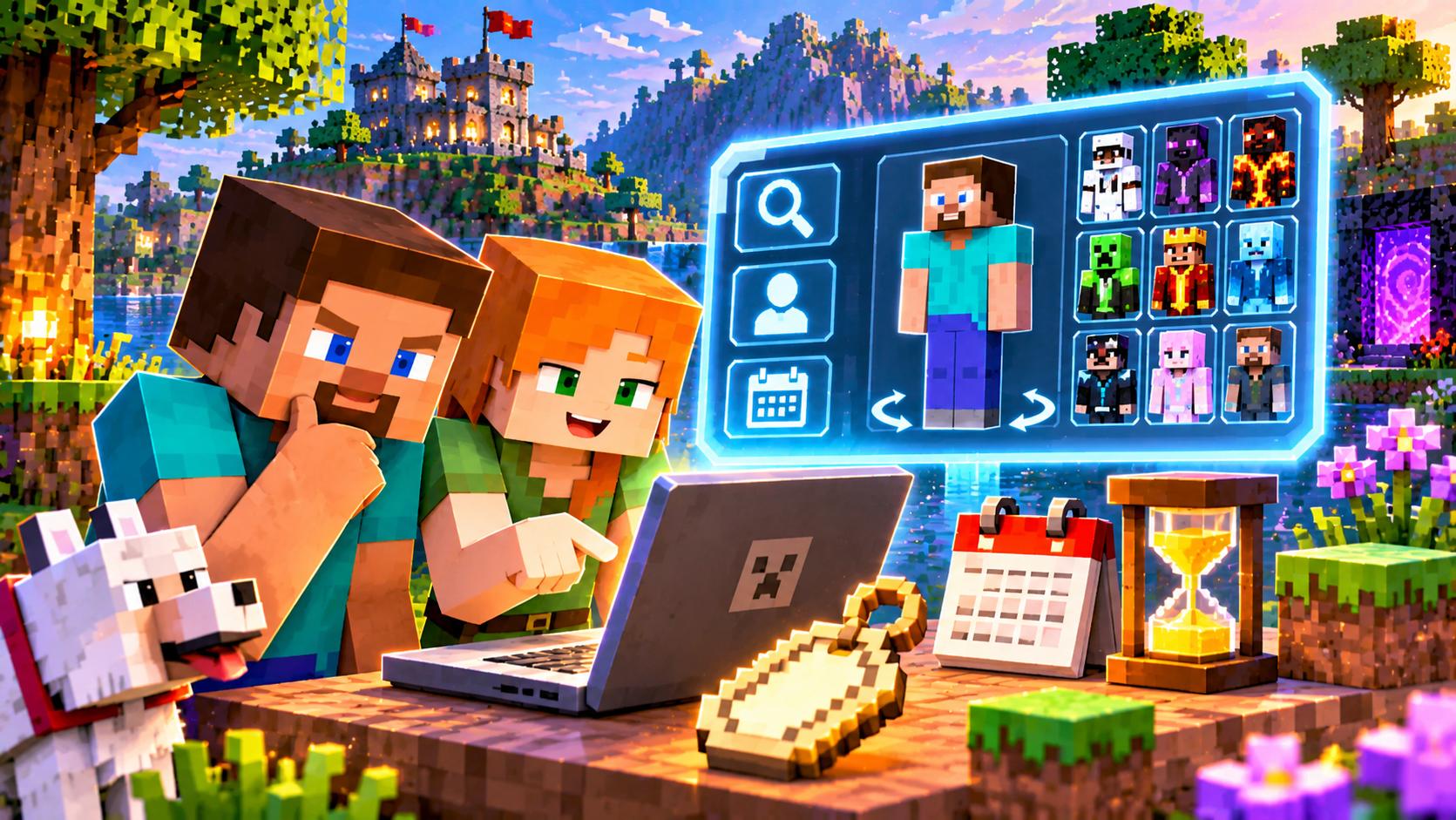
The Crafty portal, which keeps statistics across millions of accounts, rolled out a series of most curious pieces: how many items live in version 26.3 at all, who wears all eighteen armor trims, which capes count as the rarest and how often people play with standard skins. I collected these findings into one text — because Minecraft’s numbers are not boring reporting but a mirror of how people actually play.
1069 items — and that’s only the beginning
By the counts, 26.3 has 1069 craftable items, and identifiers in total — more than 1500. The difference is explained simply: some exist only as world blocks or developer tools. For a sense of the scale: physically re-crafting everything takes years of daily play. And the game keeps adding: the same calcite blockset from the fresh snapshots is another dozen new ids. Numbers vary by source — and that’s normal: somewhere they count items and not variations, somewhere block variants aren’t included.
Capes: veteran ones against mass ones
The second interesting piece is a ranking of all official capes by real rarity: how many accounts wear each of them. The logic is predictable: veteran and “tournament” capes are single units per server, mass giveaways like the cape for just launching the game are on every fifth person. A useful detail: many capes are now completely unavailable — you can only meet them on other people’s backs. And also account age: the exact creation date is seen only by the owner, while an outside observer recognizes an “old-timer” by the name history, the presence of rare capes and classic skins. We already told about the cape mechanics from Dungeons II (the hero cape for both parts) in the pieces about the game.
Nine faces of Minecraft
It turned out there are exactly nine standard skins in the game — the classic Steve and Alex, plus seven modern ones: Ari, Efe, Kai, Makena, Noor, Sunny and Zuri. Players are really distributed among them: the statistics show who and how often picks the “classic” or the slim model. Along the way it also sorted out how to look at other people’s skins: for Bedrock players skins are tied to Xbox accounts, so old skin viewer sites can’t see them at all — a useful check before googling “how to see a friend’s skin”.
Eighteen trims and five steps to an End city
The third number of the day: all eighteen Smithing armor trims — with a table of where each template drops and how to duplicate it. Useful for cosmetics hunters: trims from ancient cities and strongholds differ in rarity and style. And as a bonus — the classic cheat sheet for End cities: cities with elytra appear only on a “grid” of chunks, so beyond a certain distance from the portal it’s worth looking for them in parallel lines — and that really saves dozens of minutes of flight. In general, numbers from such big statistical projects are useful also because they help understand the value of cosmetics: before buying a “rare” trim or skin from strangers, check how many players actually wear it — that way you won’t overpay for something that’s actually mass. The horrors of deals “for half price, just transfer” we won’t break down in detail here: just remember that official Marketplace mechanics are always safer than private arrangements. The full breakdown of such guides we keep in the site’s top collections.
By the way, these same nine skins and eighteen trims are a great topic for a first video on a channel: even people who never changed their look love watching “classic versus new look” comparisons.
- 1069 items are available by crafting; the full id list is more than 1500.
- 9 standard skins; some pick the “classic”, some the slim model.
- 18 armor trims — each with its own place of extraction.
- End cities stand on a regular grid — search in lines, not chaotically.
Public statistics of skins, names and capes are a normal tool: you’re looking at a public account’s history, like a forum profile. But remember hygiene: never hand over your password or login code to anyone for “account verification”, don’t trust sites promising to show other people’s login secrets, and check the domains — Mojang shows the account creation date only to the owner. Scammers live on inattention, not on hacks.