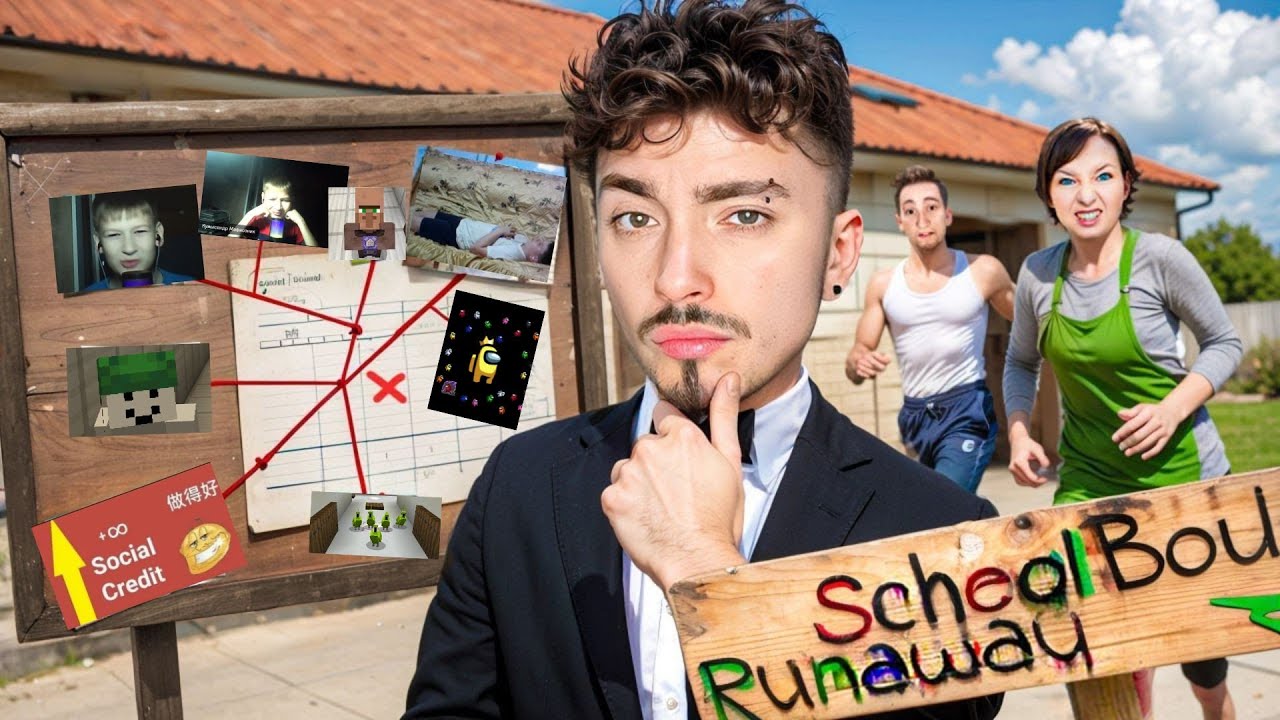
The Schoolboy Runaway rubric on the Maxx Storm channel has a special format — special episodes, where escapes stop being mere chases: the hero is summoned for a police interrogation, locked in prison, reconciled with his parents and punished again. These episodes tie the universe’s storylines into knots, so they’re worth watching separately from the regular escapes. We break down four key episodes: the reveal, the prison, the forgiveness and the first punishment where it all began.
The reveal: a field trip for the police
In the reveal special, the hero gets the policeman into a frank conversation and takes him to see the basement — the very prison where he was kept in a cage. The parents fight back with their signature line: “the kid just has a wild imagination, he dreamed it”, and by the time the police arrive the basement is already cleaned up — where the cage was there are only lockers. Then counter-investigation begins: the family’s car turns out to have no papers, the password that “always worked” suddenly stops working, and the hero answers the lies with vandalism — bans the door, nails the policemen into the same cage and leaves parkour-style across the roof until the guard shift runs out.
Prison: a resort, a cage and a kind word
In the prison episode the family’s script pool grows: dad returns from the “Delfin” resort, mom controls lessons and PE, and the hero answers by nailing the gate shut, mining a key card, working an axe and locking the adults in himself — the title “evil parents lock me in prison” works in both directions here. The cage is no metaphor: “I don’t want to go in the cage” is said in the round in earnest. The finale is unexpectedly soft: mom comforts the hero — “you’re actually a good boy”, and about the parents she adds that they’re actually good too and just won’t admit it.
Forgiveness and the first punishment
The reconciliation arc starts back in the orphanage: after the scandal with the vitamins laced with sleeping pills, the stolen recipe cards and the door with eighty locks, the hero runs away — but comes back on his own to apologize and ask to be taken back to his parents. And the origin of the whole story lies in the first punishment: there Lyokha and Deni got so deep into the evil-parent role that a whole system of distractions had to be invented — doorbell rings, soapy water and eggs, burnt cutlets with a two-nil score and a final dash to the gate by key card.
How specials differ from regular episodes
In regular episodes the drama rests on timings and hiding spots; in specials there are witnesses, interrogations, reconciliations and punishments as a full-fledged mechanic — from the shame room and sleeping on hay to the cage and “prison”. The parent cast changes from season to season, but the formula is one: the louder the hero’s failure, the warmer the finale. That’s exactly why specials play like chapters of a series, not separate rounds.
Where to start watching
Start with the reveal episode above — it’s the loudest and shows the format best. Then gather the context: the basic escape breakdown explains the rubric’s rules, the escape routes rating suggests the episode order, and the channel and team page introduces the cast.
A special differs from a regular round in that it has a plot twist. Lay in three scenarios: an interrogation, where the hero shows the inspector his evidence and the “family” makes excuses; a prison with a cage or a locked room that needs a new way out; and a reconciliation with a kind word in the finale, so the story doesn’t end on a sad note. Prepare the props in advance — key cards, an axe, passwords, car papers — and split the roles so every “parent” has their own signature line like “you dreamed it”. And don’t forget punishments as a mechanic: it’s exactly them that make a special an event, not just another escape.