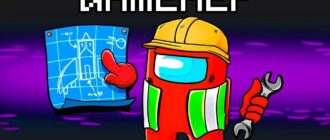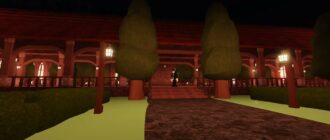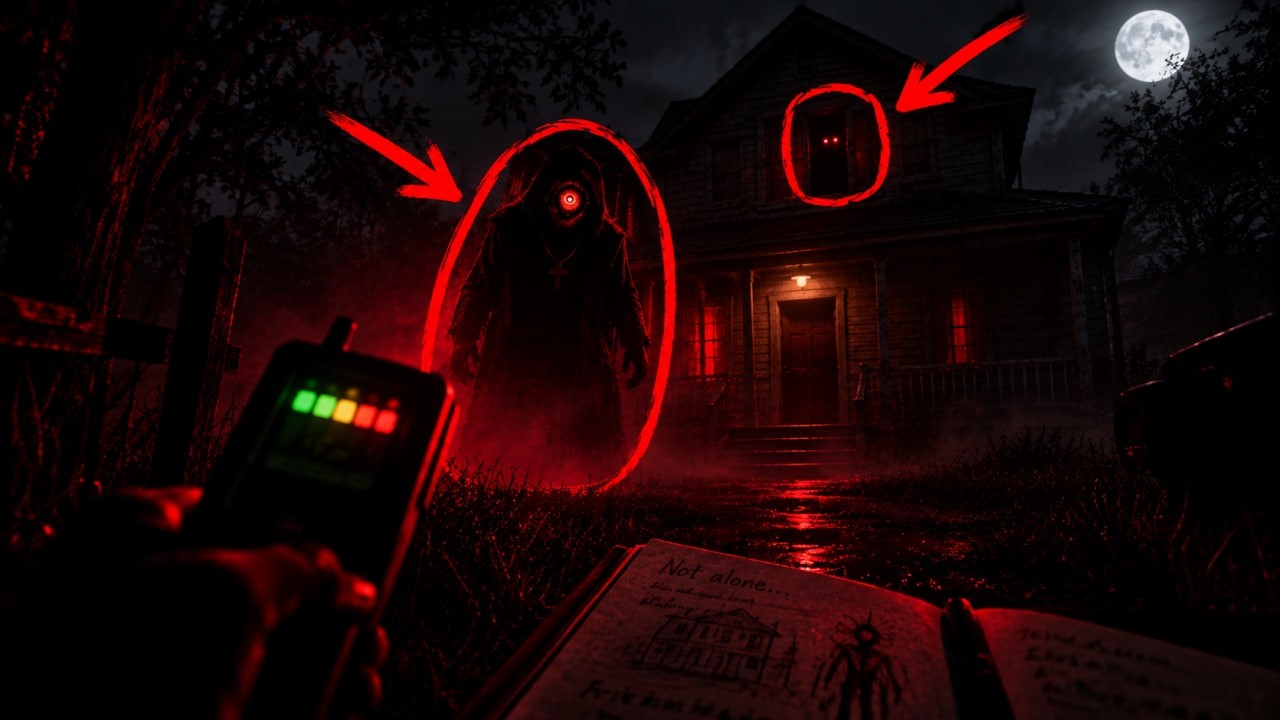
The third disclaimer in a row, and an important one: Demonologist isn’t Minecraft but a PC co-op horror on Steam. In the Russian-speaking internet the game is called “Demonology”, and its essence is detective-like: a team enters a house, collects evidence and figures out which exact ghost lives there. We play with webcams — meaning you see our live faces next to the plasticine-with-fear ones.
The game’s point: not to run away but to name the ghost
The main mechanic of Demonology is deduction. The ghost in the house belongs to one of many types, and each has its own set of evidence. Victory — isn’t escaping but correctly crossing out all the extra types and naming the one that’s actually there. Hence the session’s structure: placed the equipment, gathered reactions, checked against the journal, crossed out — and so on in a circle until one remains in the list.
Equipment: how the invisible is listened to
- The EMF reader — catches activity spikes: the stronger the peak, the closer the ghost was.
- The spirit book — the ghost sometimes writes in it itself; the handwriting and the words are evidence too.
- Energy clocks — show the team’s sanity: the lower it is, the angrier the house behaves.
- Flowers and a pot — influence indicators: blackening flowers and a destroyed pot say the ghost “walked” exactly here.
- Cameras — the team’s eyes from outside: an operator watches whoever is inside.
The hunt: the minutes when the game honestly scares
Once per session (and on high difficulty — more often) a hunt begins: the ghost stops hiding and starts looking for people. The light flickers, a door may close itself, and the player inside makes the only correct move — turns off the flashlight and sits in the closet. In our episode the hunt began exactly when we were arguing whose turn was to go first — a perfect illustration of why a team needs an “elder” who says “quiet”, not “go”.
How we identified the ghost (and where we erred)
In the embedded episode the evidence stacked like this: the EMF gave peaks, the spirit book was filled with calligraphy, the flowers blackened, the pot was destroyed, and the EMF at its peak showed a value that narrows the list to a couple of types. The first candidate — Vesper — was logical but wrong: after checking the evidence the list narrowed to the Aswang, which didn’t answer questions and therefore pretended to be a “quiet house” all evening. Grepa, who went first, played his role in this story fully — which is why he made it into the episode’s title.
Why the webcam format works
Horrors in company are valuable for reactions, and Demonologist with webcams is essentially a reality show: while one whispers “I’m in the closet, please don’t climb in after me”, the other asks the ghost about the weather in a calm tone. The same principle as in our “Backstage” show — fear from the setting, not from jumpscares. The team lineup and the filming schedule — in the channel section.
The bottom line: Demonologist is a detective disguised as a horror. Evidence matters more than courage, the closet matters more than the flashlight, and the scariest moment of a session isn’t the hunt but the moment you realize: you crossed out the wrong type, and your partner went to check it personally.
The first session — on low difficulty: hunts are rare, more evidence, sanity drops slower. Distribute the equipment in advance: the reader and the book — for “walkers”, the clocks and cameras — for “sitters”. Talk to the ghost out loud: some types react to voice, and that’s evidence too. And build the habit of saying out loud “I’m going to the closet” — half of the deaths in co-op horrors happen because the partner didn’t understand where you are.